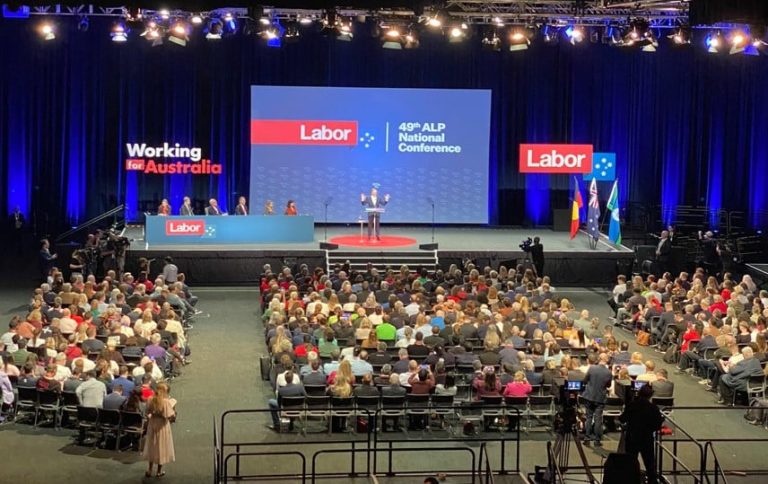
In April, Australia’s Deputy Prime Minister and Defence Minister, the Hon Richard Marles MP, and Shadow Defence Minister, Senator James Paterson, addressed the National Press Club, responding to the release of the 2026 National Defence Strategy (NDS) and Integrated Investment Program (IIP).
Both Minister Marles and Senator Paterson were speaking to the same strategic moment – one defined by intensifying military competition, eroding constraints on coercion and rising regional risk. While their assessments of the threat environment were broadly aligned, their prescriptions for how defence policy should be governed, funded and explained were not.
Join Nexus APAC as we examine the differing approaches taken by Australia’s leading defence policymakers.
Richard Marles: Institutional Confidence
Minister Marles’ political formation sits firmly within Labor’s institutional tradition. Raised in Geelong, he is the son of Donald Marles, a senior educator, and Fay Marles, Victoria’s first Equal Opportunity Commissioner and later Chancellor of the University of Melbourne. He entered political life through student politics and the union movement. After training as a lawyer, he rose through the union movement, ultimately serving as Assistant Secretary of the Australian Council of Trade Unions before entering Parliament in 2007 as the Member for Corio.
His background was evident in his National Press Club address launching the 2026 NDS. The framing was deliberately managerial, even as he employed stark strategic language describing Australia’s circumstances as the most complex and threatening since the Second World War and highlighting the global erosion of constraints on the use of force.
Minister Marles emphasised coherence, sequencing and institutional discipline: a biennial strategy cycle, large-scale funding increases over the decade, and accelerated progress across submarines, long-range strike, autonomous systems and defence industry. Political durability, in this frame, flows from Cabinet process, fiscal credibility and sustained execution. This is evident in his statement that defence spending is won “around the ERC table”.
Defence capability, for Minister Marles, is secured through structured Cabinet decisions, long-term planning and the steady alignment of strategy and resources.
James Paterson: Social Licence and Political Risk
Senator Paterson’s political trajectory is markedly different. Born in 1987, he entered politics from policy and advocacy rather than party machinery. He joined the Liberal Party as a teenager despite coming from a Labor- and Greens-voting family, was active in student politics at the University of Melbourne, and later worked at the sharp end of ideological debate at the Institute of Public Affairs, ultimately serving as its Deputy Executive Director before entering the Senate at age 28.
His National Press Club address, delivered as an explicit response to the government’s defence strategy, was defined by impatience with what he argued was euphemism and managerial language. Senator Paterson criticised the use of technocratic phrasing in official documents, arguing that it obscures risk rather than explains it. For example, he argued that terms such as “uncertain” obscure realities better described as dangerous.
Senator Paterson also pointed directly to Cabinet budget processes, particularly the Expenditure Review Committee, as the arena where defence repeatedly loses out, and questioned whether accounting reclassifications and deferred capabilities deliver sufficient near-term deterrence at a moment of rising strategic risk.
Unlike Minister Marles, Senator Paterson located the defence funding challenge not inside strategy design but inside public consent. He argued that defence struggles to win sustained investment because political leaders have failed to earn and sustain the social licence required to justify long-term trade-offs. Without greater candour about the likelihood of conflict and Australia’s current preparedness, he suggested, defence investment remains politically fragile regardless of strategic logic.
For Senator Paterson, transparency and public understanding are not democratic add-ons, but strategic enablers. In his telling, social licence is essential to deterrence because it underpins the willingness of governments to spend, sustain and adapt over decades.
Areas of Alignment
Despite the differences in tone and emphasis, the speeches also revealed substantial alignment. Both Minister Marles and Senator Paterson identified China’s military modernisation and coercive behaviour as central strategic challenges.
Both endorsed greater Australian self-reliance alongside alliances, not isolation. Neither questioned AUKUS as a core pillar of future capability, nor the indispensability of the US alliance.
The divide, therefore, is not one of direction, but of pace, communication and comfort with political risk.
Leading the Defence Portfolio
Historically, the Defence portfolio has rewarded those able to balance urgency with stability. Too much reassurance risks complacency; too much alarm risks eroding confidence. In a decade defined by deterrence, industrial mobilisation and fiscal competition, the central challenge is not simply what Australia builds, but how enduring political support for that effort is maintained.
How Minister Marles and Senator Paterson navigate the tension between institutional confidence and social licence will shape not only Australia’s defence posture, but the political durability of its national security settings in the years ahead. In the decade ahead, misjudgement will carry consequences measured not in political cost, but in national security.